

Know Your Sport Specific Forces…
The Future is Here, and We Have It…
Leo Mazzone MLB pitching Coach Mazzone has earned a reputation as one of the best pitching coaches of the modern era, having molded Tom Glavine and John Smoltz into perennial All-Stars. Greg Maddux also enjoyed his best seasons under Mazzone. Between 1991 and 1998, three of his pitchers won a total of 6 Cy Young Awards:
Tom Glavine - 1991 and 1998
Greg Maddux - 1993, 1994, and 1995 (also won the award in 1992 with the Chicago Cubs)
John Smoltz - 1996
” You are not just another pretty face. I’ll back you 100%. Baseball needs people like you that can relate to more than just analytics.”
Leo Mazzone on Kinetic Force Analysis
If it Moves. We Can Analyze it…
*
If it Moves. We Can Analyze it… *
Know What’s in Your Tank and How to Train it…
We Feature Multiple analysis packages that are sports specific

KFA Analysis Tiers: Side-by-Side Comparison
Sources: KFA Services Overview
🧠 Strategic Implications for GM-Level Use
• Basic gives you a mechanical “red flag” scanner—great for filtering risk or validating rehab.
• Intermediate adds torque-phase intelligence, ideal for identifying undervalued arms or refining sequencing.
• Full delivers a 14-dimensional, timestamped biomechanical fingerprint—ready for trade modeling, contract structuring, and postseason deployment.
KFA Analysis Tiers: Side-by-Side Comparison
Sources: KFA Services Overview
🧠 Strategic Implications for GM-Level Use
• Intermediate adds torque-phase intelligence, ideal for identifying undervalued arms or refining sequencing.
Core Deliverables of KFA Basic Analysis
• Biomechanical Ground Truth: Captures force data across critical movement phases—especially in pitching or hitting—to establish a baseline of mechanical efficiency.
• Injury Risk Indicators: Highlights asymmetries, torque inefficiencies, and deceleration control issues that may signal elevated injury risk.
• Performance Bottlenecks: Surfaces mechanical limitations that could be holding back velocity, command, or repeatability.
• Scouting & Development Utility: Offers visual dashboards that help coaches and scouts identify undervalued athletes or validate rehab progress.

Core Deliverables of KFA Basic Analysis
• Biomechanical Ground Truth: Captures force data across critical movement phases—especially in pitching or hitting—to establish a baseline of mechanical efficiency.
• Injury Risk Indicators: Highlights asymmetries, torque inefficiencies, and deceleration control issues that may signal elevated injury risk.
• Performance Bottlenecks: Surfaces mechanical limitations that could be holding back velocity, command, or repeatability.
• Scouting & Development Utility: Offers visual dashboards that help coaches and scouts identify undervalued athletes or validate rehab progress.
• Cost-Effective Entry Point: At $500, it’s the most accessible tier in KFA’s four-level system (Basic, Intermediate, Professional, Full), making it ideal for individuals or teams starting biomechanical integration.
🧩 How It Fits into GM Strategy and Baseball Ops
• Roster Optimization: Flags biomechanical undervaluation—useful for trade filters, draft prioritization, and contract structuring.
• Health Forecasting: Supports proactive intervention planning by identifying trends toward injury before symptoms surface.
• Coach Integration: Enables frictionless handoff between analytics and coaching staff, aligning mechanical data with training plans.
📊 Visual & Modular Reporting
• KFA’s reports are designed for clarity and speed—modular dashboards, annotated visuals, and force-phase overlays that plug directly into tactical workflows.
TEAM ANALYSIS IS CASE BY CASE BASIS
Our Services
KFA (Knowledge, Frameworks, and Action) provides athletes of all kinds—elite, developmental, or recreational—with a modular, evidence-based ecosystem designed to elevate performance, resilience, and decision-making. Here's what KFA delivers across the spectrum:
🧠 Knowledge
• Biomechanical Analysis: Frame-by-frame breakdowns of movement patterns, identifying inefficiencies and injury risks.
• Injury Matrices: Multi-dimensional overlays comparing athlete health profiles, recovery timelines, and risk factors.
• Tactical Briefings: GM-level scouting reports, matchup analyses, and decision trees tailored to sport-specific contexts.
🧰 Frameworks
• Modular Tactical Systems: Color-coded cards and overlays for in-game decision-making, adaptable across sports and levels.
• Progression Tracking: Integrated systems to monitor skill acquisition, physical development, and return-to-play benchmarks.
• Athlete Identity Mapping: Tools to align training with personal values, roles, and long-term goals.
🚀 Action
• Exercise Prescription: Customized, biomechanically sound routines based on athlete-specific needs and constraints.
• Live Feedback Loops: Real-time video analysis and tactical updates for in-the-moment coaching and adjustment.
• Leadership & Team Culture: Support for captains and coaches to foster camaraderie, accountability, and legacy-building.
🌐 For All Athletes
• Youth to Pro: Scalable systems that grow with the athlete—from foundational movement to elite performance.
• Individual & Team Sports: Adaptable to baseball, golf, soccer, track, and more.
• Injury Return & Career Transitions: Support for navigating setbacks, comebacks, and post-competition identity.
About
our company
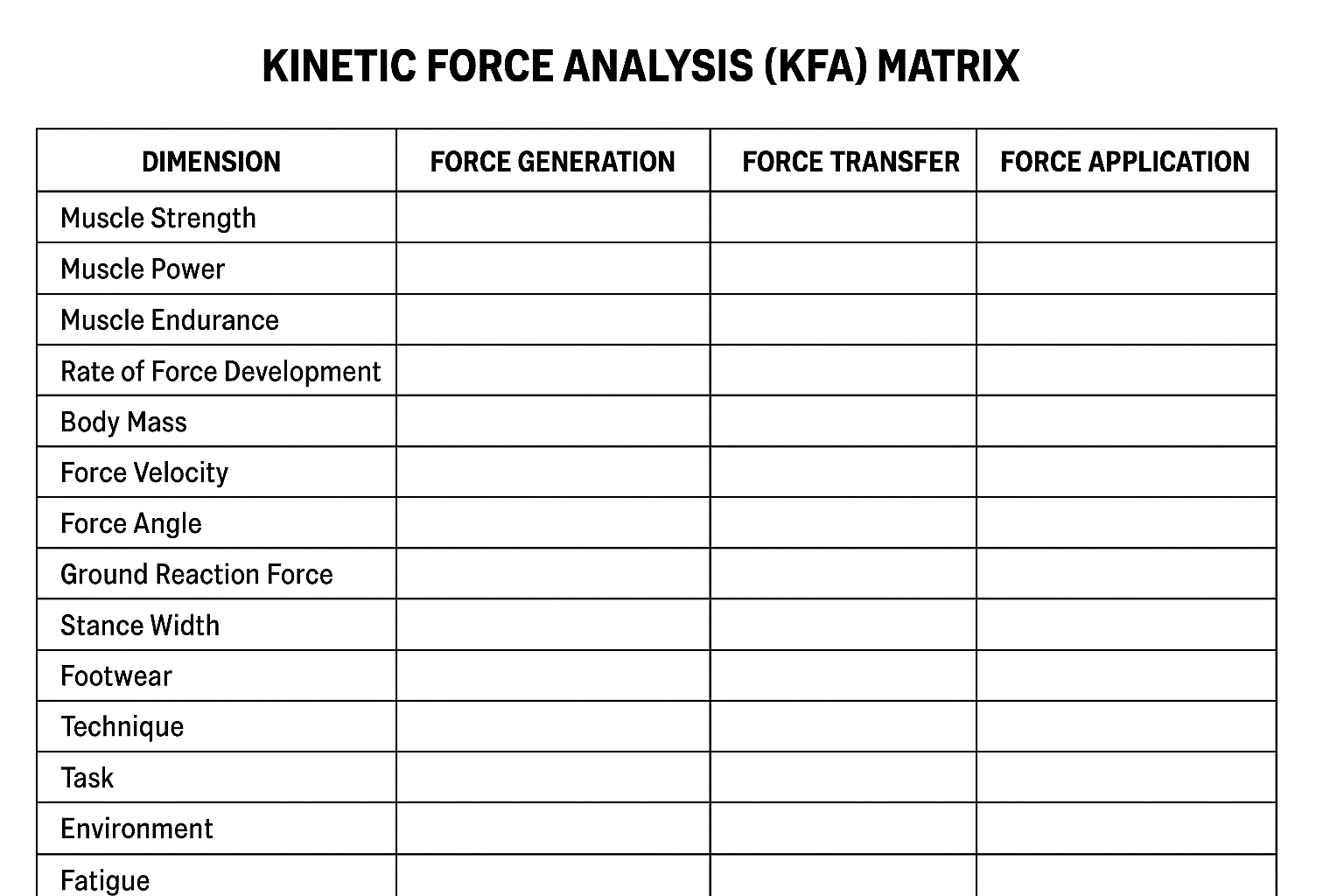
Great question, John — “Kinetic Force Analysis” (KFA) is a framework that breaks down how force is generated, transferred, and applied in athletic movements. Since you’re already working at GM-level tactical depth, let’s outline it in a way that connects biomechanics with actionable decision-making.
⚡ Core Concept of Kinetic Force Analysis
Definition:
KFA examines the magnitude, direction, timing, and efficiency of forces produced by an athlete’s body during movement.Purpose:
To identify how well an athlete converts potential energy (stored in muscle/tendon systems) into kinetic energy (motion), and whether inefficiencies or imbalances limit performance or increase injury risk.
🔑 Key Dimensions
Force Generation:
Muscle recruitment patterns (e.g., hip drive in pitching, ground reaction forces in golf swings).
Explosiveness vs. endurance trade-offs.
Force Transfer:
Sequential kinetic chain efficiency (foot → leg → core → arm → implement).
Timing mismatches that dissipate energy.
Force Application:
Accuracy of directional vectors (swing plane, stride angle).
Leverage indices (how force is maximized relative to opponent or environment).
Force Absorption:
Ability to decelerate safely (landing mechanics, follow-through).
Injury prevention through controlled dissipation.
📊 Tactical Uses
Performance Optimization:
Pinpointing where force leaks occur (e.g., weak push-off leg, late hip rotation).
Prescribing biomechanical drills to tighten the chain.
Injury Matrices:
Mapping repetitive stress points (knees, shoulders, lumbar spine).
Comparing athlete mechanics to normative baselines.
Matchup Strategy:
Identifying leverage mismatches (e.g., pitcher stride length vs. batter timing).
Building modular overlays for live decision-making.
🧩 Example Application
Pitching Analysis:
Measure ground reaction force at push-off.
Track hip-shoulder separation timing.
Overlay stride direction with release point consistency.
→ Output: A color-coded tactical card showing efficiency %, injury risk zones, and matchup leverage.

Contact Us
Interested in working together? Fill out some info and we will be in touch shortly. We can’t wait to hear from you!